
Operations teams running 100+ multi-step workflows a month spend most of that time moving work between people and tools. The decisions take minutes. The handoffs take days.
Craftbase
Multu-Agent Orchestration Platform
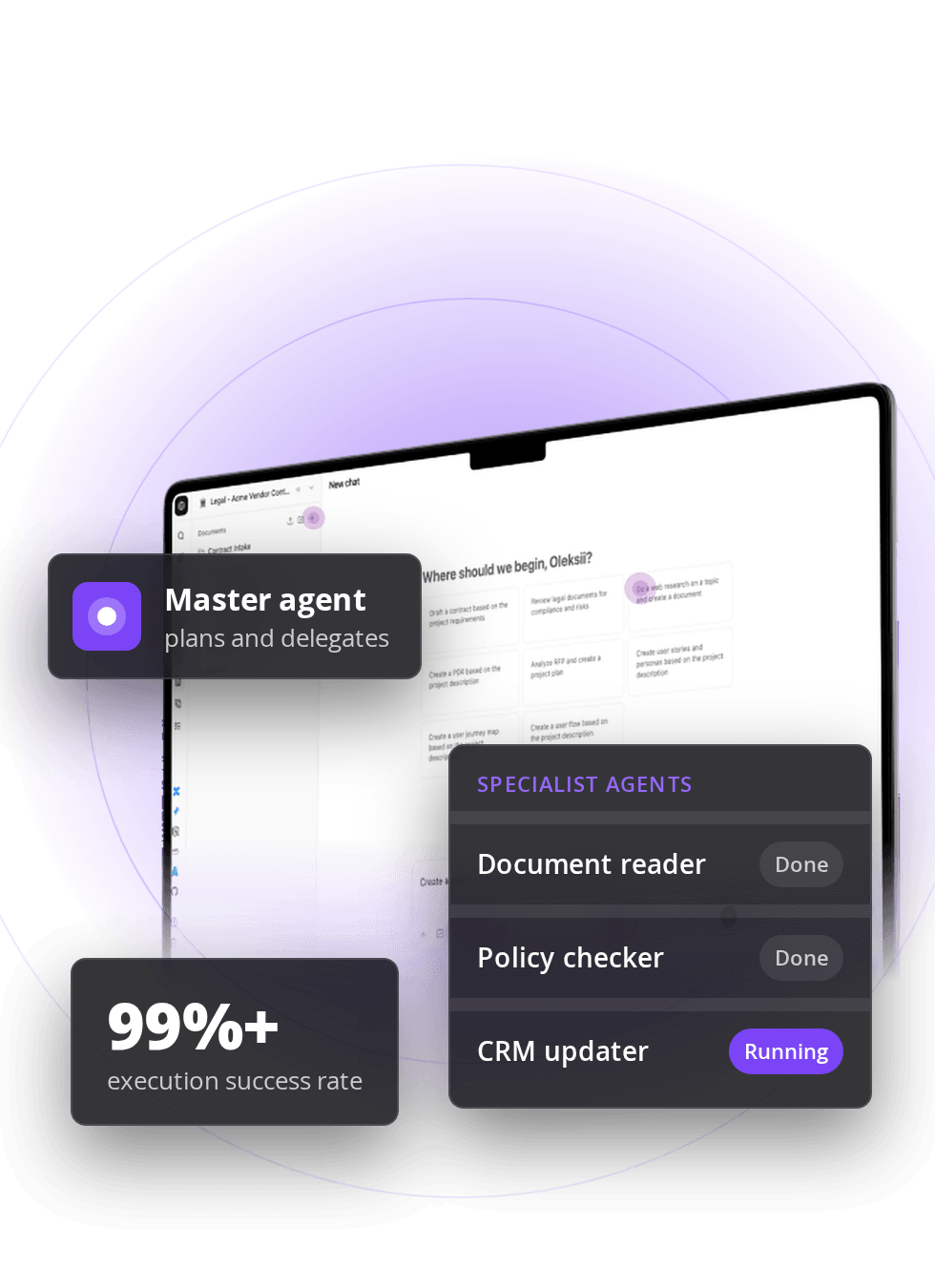
Craftbase is an AI agent platform that automates enterprise workflows end-to-end using multi-agent orchestration. One master agent plans the work. Specialist AI agents do it, in parallel, across your systems. You get a finished result, not a draft to push forward by hand. Craftbase runs in your AWS environment and deploys in under an hour.
Why one AI assistant can’t run
an enterprise workflow
Real workflows cross systems, teams, and approval steps. A single model answering one prompt at a time can help with a step. It can’t own the process from intake to completion.
Coordination eats the week
Assistants help, but a person still drives
Gen AI assistants summarize documents and draft emails well. But they wait for the next prompt. Someone still has to route the output, trigger the next system, and check that the job finished.
One agent hits a ceiling fast
Ask a single agent to read a contract, check it against policy, update the CRM, and start an approval, and quality drops as the task grows. Complex work needs a team of specialized agents with a coordinator, which is what multi-agent orchestration provides.
The platform
What is Craftbase?
A multi-agent orchestration platform
built on AWS Bedrock
Craftbase is an AI agent platform from Euristiq that automates enterprise workflows end to end through multi-agent orchestration. A master agent reads your request, breaks it into tasks, and delegates each one to a specialist sub-agent. Sub-agents run in parallel or in sequence, each on the model best suited to its role. The platform returns a completed result that doesn’t need a person to push it forward.
Natural language intake
Plain-English requests, converted into workflow plans at 85%+ accuracy.
Master agent + specialist sub-agents
Each agent runs the optimal model for its role. Swap a model without rebuilding the workflow.
15+ pre-built workflow types
Document processing, approval routing, and data integration pipelines out of the box, configurable to your processes.
AWS-native infrastructure
Runs on AWS managed services and stays entirely within your infrastructure.
Full audit trail
Every agent action is logged. Human-in-the-loop gates are configurable per workflow. On-premises deployment is available for regulated industries.
How it works
How multi-agent orchestration
works in Craftbase
- Intake01
Intake
You describe the task in plain English. Craftbase parses intent with 85%+ accuracy and turns it into a structured plan. No prompt engineering. - Planning02
Planning
The master agent splits the plan into tasks and maps the dependencies between them. - Delegation03
Delegation
Each task goes to a specialist agent, for example a document reader, a policy checker, or a CRM updater, with its own tools and LLM. - Execution04
Execution
Independent tasks run in parallel. Dependent tasks run in order. Human-in-the-loop gates pause only where you set them. - Delivery05
Delivery
The master agent assembles the outputs, logs every action, and delivers the finished result to the system where it belongs.
01
Intake
You describe the task in plain English. Craftbase parses intent with 85%+ accuracy and turns it into a structured plan. No prompt engineering.
02
Planning
The master agent splits the plan into tasks and maps the dependencies between them.
03
Delegation
Each task goes to a specialist agent, for example a document reader, a policy checker, or a CRM updater, with its own tools and LLM.
04
Execution
Independent tasks run in parallel. Dependent tasks run in order. Human-in-the-loop gates pause only where you set them.
05
Delivery
The master agent assembles the outputs, logs every action, and delivers the finished result to the system where it belongs.
Use cases
Enterprise workflow automation
that runs from start to finish
Built for operations teams, IT departments, and professional services firms running 100+ workflows a month.
Document processing automation
30–50%
less manual processing time on document workflows
Agents read, classify, and route contracts, invoices, and reports. No one has to hand off each document.
Approval workflow automation
Hours, not days
for complex approval chains
Multi-step approval chains run as one connected sequence. People step in only at the decision points you define.
Data integration pipelines
Zero
manual exports
Agents pull data from several source systems, reconcile it, and push clean outputs downstream, on a schedule or on an event. The pipeline audits itself and flags exceptions for review.
Features
Craftbase key features
Everything your agent crew needs, in one privately deployable platform.
Agent builder
Agent builder
Build your own agents or pick from a library of specialist agents. Assign each one a role, tools, and an LLM. No code required.
Workflow builder
Workflow builder
Chain agents, tools, and conditional logic into multi-step workflows in minutes. Each step can be static or handled dynamically by an agent.
LLM agnostic
LLM agnostic
Plug in GPT, Claude, Gemini, DeepSeek, or open-source models hosted in your own infrastructure. Give each agent the best model for its job and swap models without rebuilding pipelines.
Document management
Document management
Documents created in Craftbase or imported from Google Drive, SharePoint, and other sources live in one AI-searchable place. Ask questions, generate documents from templates, and automate document workflows.
Call transcribing
Call transcribing
Record and transcribe Zoom, Google Meet, and Microsoft Teams calls automatically. Calls become searchable project knowledge that agents can query.
Workspaces
Workspaces
Each project gets an isolated workspace with its documents, chats, agents, and transcripts. Agents keep full context across the workspace, so nothing is lost between steps.
History and traceability
History and traceability
Every agent interaction and AI response is versioned, auditable, and source-linked. Your team can always see what happened, when, and why.
Organization and access management
Organization and access management
Tenant-level data isolation, role-based access, and multi-workspace management from one admin layer. Built for rollout across departments and compliance boundaries.
Private deployment
Private deployment
Run Craftbase on-premises or in a dedicated private cloud. Documents, calls, and agent outputs never leave your environment.
Integrations
Integrations
Slack, Google Drive, SharePoint, Jira, Confluence, Salesforce, Zoom, Google Meet, Microsoft Teams, email, and custom APIs.
Who it’s for
Built for every stage of AI adoption
Whether your teams are testing their first AI tools or scaling agents across departments, Craftbase gives them one governed place to do it.
Early explorers
Your teams paste work into ChatGPT and save one-off prompts. Results look promising but stay scattered, with no visibility, no governance, and no way to scale what works.
Power users
Your advanced users want custom workflows and their choice of models. Security requirements and integration work keep blocking them. Craftbase gives them multi-agent orchestration inside approved boundaries.
Security and compliance teams
You see the risks: shadow AI, data leaking to external tools, no audit trail. Blocking AI isn’t the answer. Craftbase keeps data in your environment and logs every agent action.
For enterprise operations
Sales
Automate RFP analysis, proposal generation, and customer communication tracking. Summarize client meetings, extract requirements, and draft tailored proposals.
Operations
Streamline operational workflows, automatically summarize team updates, extract KPIs, identify bottlenecks, and generate action plans. Craftbase is especially relevant for Recruiting, HR, Project Management functions.
Legal
Review and redline contracts, summarize legal documents and compliance reports, extract insights from case files and meeting transcripts, and auto-generate client-ready summaries or briefs.
Finance
Process financial statements, investor decks, and regulatory filings faster. Automatically extract key metrics, identify anomalies, and prepare compliance reports.
Production
Process large project orders, proposals, optimize maintenance and compliance workflows. Analyze inspection reports, supplier certifications, and production logs, identifying risks or non-compliance.
See Craftbase automate a workflow for your business
Free discovery and a working prototype in one week.
Comparison
Microsoft Copilot alternative:
Craftbase vs. Copilot for workflow automation
Microsoft 365 Copilot is a strong assistant inside Word, Outlook, and Teams. Copilot Studio now adds agent building and multi-agent orchestration for the Microsoft stack. Craftbase is built for a different job: running autonomous, cross-system workflows inside your own AWS or on-prem environment, with any model you choose, set up by Euristiq engineers around your processes.
When Copilot is the right fit
Your work lives in Microsoft 365 and you want AI help with drafting, summarizing, and meetings.
When Craftbase is the right fit
Your workflows span AWS, Salesforce, custom databases, and internal APIs, data must stay in your infrastructure, and you need the workflow to finish on its own.
Craftbase vs. Microsoft Copilot comparison
Capability | Craftbase | Microsoft copilot |
|---|---|---|
Primary job | Autonomous end-to-end workflow automation | Productivity assistant in M365; low-code agent builder |
Where it runs | Your AWS account, private cloud, or on-premises | Microsoft cloud, in your M365 tenant |
Models | Any LLM per agent, including self-hosted open-source models | Models offered through Microsoft and Azure AI Foundry |
Ecosystem | AWS-native, any system via API | Built around Microsoft 365 and Microsoft Graph; other systems via connectors |
Deployment | Core platform in under 1 hour via CloudFormation | SaaS licensing; agents built by your makers |
Implementation | Euristiq engineers scope, build, and prove your workflows | Self-service or a Microsoft partner |
Pricing | Free workshop, $10K PoC, $50K/year platform license; not per seat | $30/user/month (annual) on top of a qualifying M365 plan, plus agent usage |
Craftbase pricing
Start small and scale when it works. Craftbase is designed to deliver 400% ROI: $4 saved for every $1 spent. Pricing follows the workflows you automate, not your headcount. Every engagement starts with a focused, low-risk first step.
Strategy workshop
Identify 2-3 high-impact AI use cases for your business
FREE
Up to 4 hours
Book a workshop What’s included
> AI opportunity mapping
> ROI calculation
> Practical roadmap
Rapid PoC
Validate your Craftbase implementation idea before making the full investment
$10K
1 week – one-time cost
Book a call What’s included
> Focused use case scoping
> Working AI workflows in your environment
> White-labeled environment
> Clear MVP roadmap
MVP + Production
Get a working Craftbase AI solution with core features
Custom
2-6 months to full build
Request estimate What’s included
> Full product build
> Custom workflows and white-label UI
> Third-party integrations
> Source access under license
> SaaS / Dedicared / On-prem deployment
Platform license
Get a full feature build-out and ongoing access
$50K
per year
Request estimate What’s included
> Aligned incentives – no lock-in
> Annual license
> Scales with your demads
How to get started with Craftbase?
Before you commit to anything, we run a free discovery session to understand your environment and map the options that make sense for you.
01
Contact us
Reach out via the form. Tell us what you want to automate, or just describe the problem. No RFP required.
02
Free discovery session
A Euristiq solutions engineer maps your workflows, data sources, systems, team structure, and compliance needs. No cost, no obligation.
03
Environment assessment
We find where AI agents will deliver the highest ROI and flag integration or security points specific to your stack.
04
Options and recommendation
You get two or three deployment options, from a single-workflow pilot to a multi-agent rollout, each with timeline, effort, and expected outcome.
05
Your decision
Proceed and we scope the PoC together. Or keep the assessment. No pressure.
See Craftbase automate your workflows in 2 weeks
We identify it, build it, and prove it works.
You decide whether to scale.

FAQ
What is a multi-agent orchestration platform?
A multi-agent orchestration platform coordinates several specialized AI agents so they can complete one complex task together. A coordinating agent plans the work, assigns subtasks to specialist agents, manages the order they run in, and combines their outputs. Craftbase does this with a master agent and specialist sub-agents, each on the model best suited to its role.
What is the difference between an AI assistant and an AI agent platform?
An AI assistant, such as Copilot or ChatGPT, responds to a prompt and helps a person finish a task. The person still decides each next step. An AI agent platform takes a goal, builds a plan, delegates tasks to agents, executes them across your systems, and delivers the result. Assistants make individuals faster. Agent platforms make whole workflows autonomous.
What is enterprise workflow automation?
Enterprise workflow automation runs multi-step business processes, such as document intake, approvals, and data syncs, across departments and systems with minimal manual handoffs. AI agents extend it to steps that need judgment, like reading a contract or classifying a request.
Can Microsoft Copilot do multi-agent orchestration?
Yes. Copilot Studio supports multi-agent orchestration, mainly for agents inside the Microsoft ecosystem. Craftbase is the better fit when workflows run on AWS or other non-Microsoft systems, data must stay in your own infrastructure or on-premises, or you want to choose any model per agent, including self-hosted ones.
What is the best alternative to Microsoft Copilot for enterprise teams?
It depends on the job. For drafting and summarizing in Microsoft 365, Copilot works well. For teams running 100+ workflows a month that need autonomous, cross-system execution, Craftbase is built for that. It runs on AWS Bedrock, connects to any system via API, and deploys in under 1 hour. In a pilot, it cut manual processing time by 34% at 1,000+ daily executions with a 99%+ success rate.
Is Microsoft Copilot free?
Copilot Chat is included with eligible Microsoft 365 business subscriptions. The full Microsoft 365 Copilot for enterprises costs $30 per user per month on an annual plan, on top of a qualifying Microsoft 365 license. For 500 users, that is $180,000 a year before any custom integration work.
How long does it take to deploy Craftbase?
Under 1 hour for the core platform. CloudFormation templates provision the full AWS stack in one zero-touch deployment: ECS Fargate, Amazon SQS, EventBridge, ElastiCache Redis, an Application Load Balancer, and RDS PostgreSQL. Custom workflows and integrations are scoped during the PoC.
How secure is Craftbase?
Craftbase can run on-premises or in a dedicated private cloud, so your data stays under your control. Each workspace has tenant-level data isolation, encryption, role-based access controls, and a full audit trail of agent actions.
How does Craftbase pricing work?
It starts with a free strategy workshop of up to 4 hours. A Rapid PoC costs $10K and delivers working workflows in your environment in one week. MVP + production is scoped to your product, typically 2–6 months. The platform license is $50K per year. Pricing scales with adoption, not headcount.
